
In the field, the difference between a bed bug treatment that holds and one that has to be repeated three times almost never comes down to the product. It comes down to the state of the home on the day of the intervention. A technician who walks into a bedroom where the bed is pushed against the wall, where three bags of laundry are lying on the floor and where the baseboards are hidden behind a full chest of drawers can only treat a fraction of the hiding places. The surviving bugs move back in within a fortnight.
Preparation isn't a courtesy extended to the contractor: it's half the job. It happens in the 48 hours beforehand, in a specific order, and several seemingly "common sense" moves must in fact be avoided at all costs.
Why preparation decides the outcome
The bed bug (Cimex lectularius) doesn't live on the skin and doesn't stay out in the open. It spends most of its time in dark crevices, less than two metres from where its host sleeps: mattress piping, bed frame and slats, headboard screws, the baseboard-to-floor joint, lifting wallpaper, curtain tracks, the backs of picture frames, electrical socket housings.
A professional treatment — residual insecticide applied into cracks and crevices, dry steam, sometimes heat treatment — only kills what it reaches. ANSES (the French Agency for Food, Environmental and Occupational Health and Safety), in its opinion on bed bug control, stresses the same logic: effectiveness relies on combining mechanical methods with physical access to the harbourages, not on spraying alone. In other words: anything that stays inaccessible stays alive.
That is also why we work in the order of the Méthode Verrou (Deadbolt Method) — detect, neutralise, exterminate, monitor. Preparation belongs to the "detect/neutralise" phase: it both reduces the population and opens up the worksite.
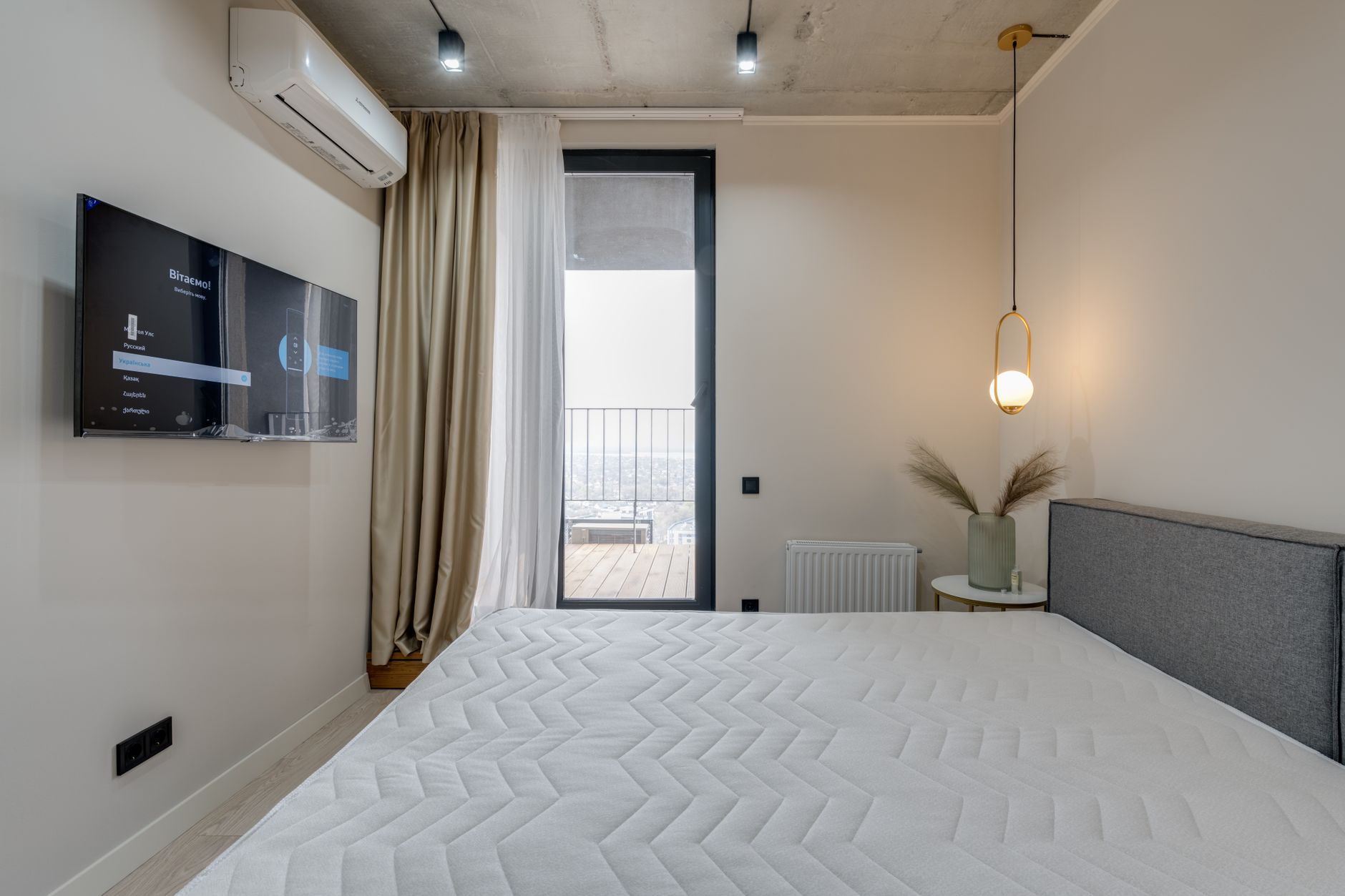 Modern bedroom with a stripped white mattress, wall-mounted TV, air conditioner and French door
Laundry: the only part where you really do kill bed bugs
Laundry is the most important item on the list, because it's the only one where a householder reliably eliminates insects and eggs without any product.
What goes in the machine
Everything washable goes into the machine at 60 °C minimum, full cycle, then into the tumble dryer for 30 minutes on a hot cycle if the fabric can take it. Heat is lethal at every life stage, eggs included. A wash at 30 or 40 °C is not enough: bed bugs survive it.
This covers:
- sheets, duvet covers, pillowcases, duvets, blankets, throws;
- every item of clothing in the wardrobes and drawers of the treated room, worn or not;
- curtains and net curtains, bedside rugs, washable soft toys;
- fabric bags, suitcase covers, towels stored in the bedroom.
What can't go in the machine
Delicate garments, coats, leather: two options. The tumble dryer alone, on a gentle long cycle, remains effective if the textile tolerates it. Otherwise, freezing: at least 72 hours at -18 °C, in flat, thin bags so the cold reaches the core of the fabric. A kitchen freezer doesn't always get cold enough; a freezer thermometer lets you check the actual temperature before you start counting hours. Closed-circuit dry cleaning is the other solution, provided the laundry travels in sealed bags.
Bagging: the step everyone gets wrong
Clean, treated laundry does not go back into the wardrobe. It goes into airtight sealed bags, stored outside the treated room, and it stays there until the technician gives the green light — generally after the follow-up inspection. Large transparent zip-lock plastic bags do the job perfectly and let you see the contents without opening them.
Dirty laundry travels in a closed bag all the way to the machine, and the bag is thrown out immediately afterwards. A bag of laundry carried open through the home is contamination handed to the living room.
Simple rule: nothing textile leaves the room without a sealed bag, and nothing textile comes back in until the treatment has been validated.
Clearing access: baseboards, bed, furniture
The technician needs to reach the entire perimeter of the room. In practice, that means a clear strip of 40 to 50 cm along every wall.
The bed
- Pull the bed away from the wall and from other furniture, by at least 30 cm.
- Remove sheets and the mattress cover (see above), leave the mattress and box spring in place and accessible on all six sides: it must be possible to tip them up.
- Empty out anything stored underneath. Storage-bed drawers are pulled out and emptied.
- Dismantle the headboard if it unhooks: its screws and fixings are a classic harbourage. A small screwdriver set and an Allen key save you from calling a handyman at the last minute.
Furniture and walls
- Empty the bedside tables, chests of drawers and wardrobes in the treated room; leave drawers pulled out or open.
- Take down pictures, mirrors and frames, lay them flat in the middle of the room, face up.
- Pull furniture away from the walls to clear the baseboards around the whole perimeter.
- Don't fix anything, don't glue anything back: if a strip of wallpaper is peeling near the bed, report it, don't repair it the day before.
Vacuuming beforehand
The day before, a thorough pass with the vacuum along the baseboards, over mattress seams and in floorboard grooves cuts down the visible population, the shed skins and the poorly attached eggs. A vacuum with a HEPA filter limits the spread of allergens and debris. The bag is then removed, shut inside a sealed plastic bag and thrown out outside, not into the kitchen bin. A bagless vacuum is emptied straight into a sealed bag, then the canister is rinsed with hot water.
The mistakes that make the infestation worse
These are the most common ones, and they are expensive.
Moving the furniture into another room. It's the number one reflex, and it's the worst. You carry the bed bugs into a clean room that the treatment didn't cover. Everything stays in the treated room, simply pulled away from the walls.
Dumping the mattress on the landing. A mattress abandoned in the stairwell spreads bugs throughout the building and often ends up salvaged by a neighbour. If the mattress really has to go, it leaves wrapped and sealed, after the treatment, and it is declared at the waste facility. In most cases, a mattress that has been steam-treated and then shut inside a full bed bug-proof encasement with a secure zip is kept: the encasement traps any survivors and can be visually checked for a year.
Spraying an over-the-counter insecticide the day before. Retail aerosols and foggers scatter bed bugs into partition walls, service ducts and neighbouring flats, and they compromise the action of the residual product applied afterwards. The phenomenon is the same as with cockroaches: we covered it in detail in our piece on the German cockroach and sprays. Santé publique France (the French public health agency) and the health authorities also regularly warn about products bought outside official channels — an insecticide banned in France and sold online caused several deaths in 2026.
Sleeping elsewhere. Counter-intuitive, but leaving your bedroom for the sofa shifts the population towards the living room and widens the worksite. You keep sleeping in your own bed until the treatment.
Repainting, re-gluing or sealing the day before. Caulking cracks is useful, but after treatment, not before: otherwise you seal live bed bugs inside a wall that was never reached.
The 48-hour countdown
| When | What to do |
|---|---|
| D-2 | Start the 60 °C wash cycles; begin freezing delicate textiles (72 h minimum) |
| D-2 | Empty wardrobes, chests of drawers, bedside tables; bag the treated laundry |
| D-1 | Vacuum baseboards, mattress, box spring, floor grooves; throw the bag out outside |
| D-1 | Pull the bed away, move furniture out from the walls, take down frames and mirrors |
| D-1 | Dismantle the headboard, pull out storage-bed drawers |
| D-Day | Clear the hallways, provide access to sockets and boxed-in pipework |
| D-Day | Move pets (cat, dog), aquarium and food to safety, outside the room |
| D-Day | Plan to be away for 4 to 6 h after the intervention, then ventilate for 1 h |
The re-entry interval depends on the product and the method: the technician states it on the intervention report, along with the name of the product used and its hazard statements. You are entitled to this information; keep it.
As a tenant, in a residential building, in a short-term rental
Tenant. The French law of 6 July 1989 requires the landlord to provide decent housing, free from pest infestation; the 2018 ELAN Act confirmed this for bed bugs. In practice, a written report sent by registered letter, dated and accompanied by photos, is the document that counts. The tenant still has to prepare the home: a treatment refused or sabotaged can be held against them.
Residential building. Bed bugs travel through service ducts, baseboards and landings. Treating a single flat in an affected building is like bailing out a boat. Inspecting the adjoining homes (above, below, either side) is the managing agent's responsibility, and they can put a collective plan to the vote — we described how that vote works in our article on the pest control plan voted at a general meeting. The managing agents and buildings pages set out the coordination from the manager's side.
Short-term rental host. The preparation is the same, but the timeline changes: you need to block bookings until the follow-up inspection, not just until the treatment. See airbnb for checks between stays.
After the treatment: the phase people rush
A serious protocol involves at least two visits, two to three weeks apart, because eggs hatch after the first application and some individuals only cross the treated zone later on.
During that period:
- don't wash or scrub the baseboards and treated areas, the residual product must stay in place;
- don't put laundry back in the wardrobes before validation;
- keep the bed bug encasements on, mattress and box spring;
- place monitoring traps under the bed legs: bed leg interceptors let you check objectively whether there is still traffic;
- log every new bite with its date. A notebook is enough; it's the only reliable data for judging progress. Bear in mind that skin reactions are delayed by several days depending on the person, and the absence of bites is no proof of eradication: Ameli and Vidal both stress this individual variability.
If you put a bed back into service afterwards, a zipped box spring encasement is at least as useful as the mattress one: slatted bases often concentrate even more hiding places.
What it costs, and when to call
Preparation itself costs nothing but time: two evenings for a bedroom, a day for a whole home. It's the best investment in the whole file. For everything else, our prices are broken down by surface area and method, and an online booking sets the date for the inspection. The full guide to the species is on pests.
Unsure about the nature of the bites or the source of the infestation? Start by going back over the luggage quarantine protocol: in most of our Paris cases, the starting point is a return from a trip, a second-hand piece of furniture, or a neighbour currently being treated.
FAQ
Do I have to wash everything at 60 °C, even clothes I've never worn?
Yes, in the treated room. A bed bug doesn't distinguish between a worn jumper and one that's been folded away for six months: what it's looking for is a dark, stable crevice, and a pile of folded clothes offers dozens of them. Sorting by "suspect garments" is the classic mistake, because it invariably leaves eggs at the back of the wardrobe.
Distant rooms that are never used at night, on the other hand, can often be set aside initially, on the technician's advice after inspection. That is precisely the point of the preliminary visit: to define the perimeter to prepare, rather than emptying the entire home for no reason.
How long do I have to stay out of my home after the treatment?
Allow four to six hours as a rule, then an hour of ventilation with the windows wide open before moving back into the rooms. This interval varies with the product, the method used and the home's ventilation; it's stated on the intervention report handed over at the end of the job, along with the product name and its precautions for use.
Pregnant women, people with allergies or asthma and pets require a longer interval: mention this before the intervention so the protocol can be adapted. An aquarium must be covered and its air pump switched off during the application.
I haven't had time to prepare everything — can the intervention still go ahead?
Technically yes, but the result won't be comparable, and an honest technician will tell you before starting rather than afterwards. If the baseboards are inaccessible or the laundry hasn't been treated, part of the population escapes the treatment and recolonises the area within two to three weeks.
Better to push the appointment back a few days and be properly prepared than to burn a visit for nothing. If preparation is physically impossible — a severely cluttered home, an elderly person living alone, reduced mobility — say so when booking: clearance assistance and supported preparation can be arranged in advance.
We find how they get in. Then we seal it.
Detect, neutralise, exterminate, monitor: our certified technicians work across the whole Île-de-France region.